
This is a guest post by Joseph Zammit, driving growth for fintech and crypto businesses. By specialising in fintech and blockchain, he brings deep industry expertise to crypto startups and fintech companies, helping them navigate complex regulations and drive growth with tailored marketing strategies.
This article is a part of a series exploring blockchain, fintech, and Web3 innovations shaping the Balkans. Follow along to stay updated on transformative technologies and their real-world impact in our region.
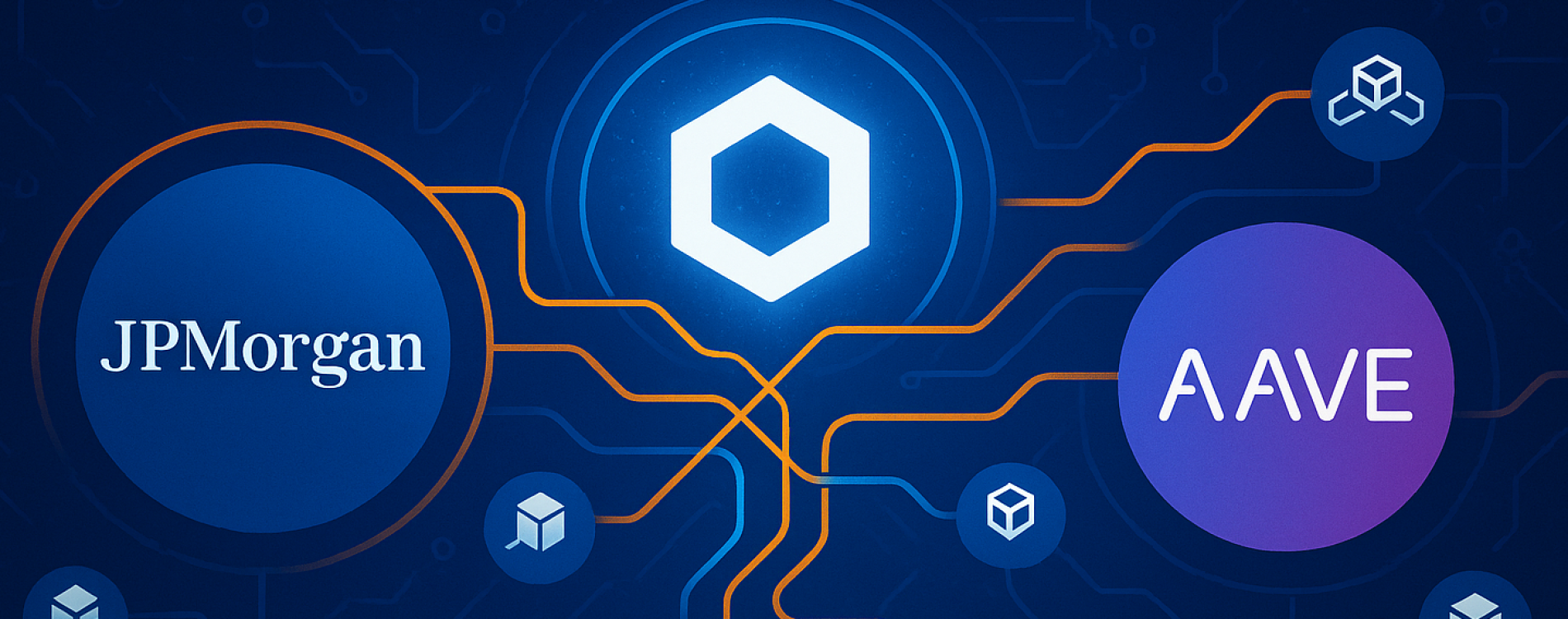
The evolution of decentralised finance (DeFi) has reached a critical inflexion point, and this time, it’s not just crypto-native builders taking notice. From JPMorgan’s latest cross-chain settlement pilot to Aave’s record-breaking $40.3 billion Total Value Locked (TVL), the institutional walls around blockchain are not just cracking, they’re opening up.
As someone who has spent years navigating the intersection between traditional finance and Web3, I believe we’re witnessing a moment of convergence that will shape the financial infrastructure of the next decade.
The Chainlink-JPMorgan-Ondo experiment
Just a few years ago, the idea of JPMorgan settling assets on a public blockchain might’ve seemed implausible. Today, it’s a reality in motion.
The recent cross-chain Delivery versus Payment (DvP) transaction between Chainlink, JPMorgan’s Kinexys platform, and Ondo Finance is a clear signal that institutional-grade DeFi is no longer theoretical. The transaction used Chainlink’s Cross-Chain Interoperability Protocol (CCIP) and Chainlink’s Runtime Environment (CRE), a modular off-chain compute layer that orchestrates workflows across both public and permissioned blockchains.
The pilot involved tokenised short-term U.S. Treasuries (OUSG) from Ondo being settled against payment instructions via JPMorgan’s Kinexys network. Importantly, no actual assets moved across chains, only transaction instructions, creating a scalable model that minimises counterparty risk while satisfying compliance requirements.
This isn’t just technical wizardry. It’s the beginning of a new cross-chain settlement standard for financial institutions.
Kinexys: JPMorgan’s bold blockchain bet
Kinexys, JPMorgan’s rebranded blockchain platform formerly known as Onyx, has already processed over $1.5 trillion in transactions. The rebrand is not cosmetic; it reflects a serious commitment to building infrastructure that moves not just money, but also data, FX settlements, and tokenised assets across global systems.
With Kinexys Digital Payments now integrating foreign exchange capabilities and expanding to public blockchains, we are looking at a hybrid model that blends regulatory assurance with DeFi composability — a model that traditional banks and regulators can live with.
Meanwhile, in the Heart of DeFi: Aave Hits $ 40B+ TVL.
While institutions experiment with cross-chain settlement, DeFi continues to set its records.
Aave, the decentralised lending giant, has achieved an unprecedented $40.3 billion in TVL, outpacing competitors like Lido DAO. This isn’t just a function of market momentum; it’s the result of deep protocol innovation.
Aave v3 introduces Efficient Mode (E-Mode) for higher borrowing capacity, Isolation Mode for tailored risk management, and gas optimisations that cut costs by up to 50%. Add to this the Portal feature enabling multi-chain liquidity flow, and it becomes clear why Aave is positioned as the infrastructure layer of choice for DeFi lending at institutional scale.
With dynamic interest rates, composable architecture, and a rapidly expanding multi-chain footprint, Aave is proving that DeFi can not only survive it can scale responsibly.
The bigger picture: Tokenised treasuries, real-world assets, and liquidity bridges
What’s tying JPMorgan and Aave into the same narrative?
One word: interoperability.
The tokenised U.S. Treasuries market has already surpassed $6 billion, and is projected to soar as institutions like BlackRock, Franklin Templeton, and Ondo lead the charge. These tokenised assets need liquidity, composability, and access to global investor bases, all of which depend on cross-chain protocols and DeFi-native infrastructure.
Meanwhile, platforms like Chainlink and Aave are building the bridges to enable those flows, not just between Ethereum and other chains, but between entire financial ecosystems.
Why this matters for the future of finance
As financial institutions tiptoe into DeFi, the lines between centralised trust and decentralised execution are blurring. The successful Chainlink-JPMorgan-Ondo transaction is not just a headline; it’s a template.
It shows us that permissioned and permissionless systems can coexist, and even collaborate, through orchestrated, compliance-ready workflows. This kind of hybrid architecture might just be the key to unlocking the next $1 trillion in blockchain-based finance.
For DeFi protocols like Aave, the message is clear: build for scale, build for safety, and build for institutions because they’re coming.
The convergence of DeFi innovation and institutional adoption is not some abstract future state. It’s happening now, in real time, across cross-chain settlements and record-breaking TVLs.
JPMorgan and Aave are no longer on opposite sides of the spectrum; they’re part of the same momentum shift. As someone who’s spent two decades translating tech disruption into market reality, I see this not as a passing trend but a paradigm shift. We’re moving toward a financial system where capital flows freely, settlements happen instantly, and value is no longer confined by legacy rails.
Welcome to the next era of finance, powered by protocols, protected by interoperability, and built for a tokenised world.