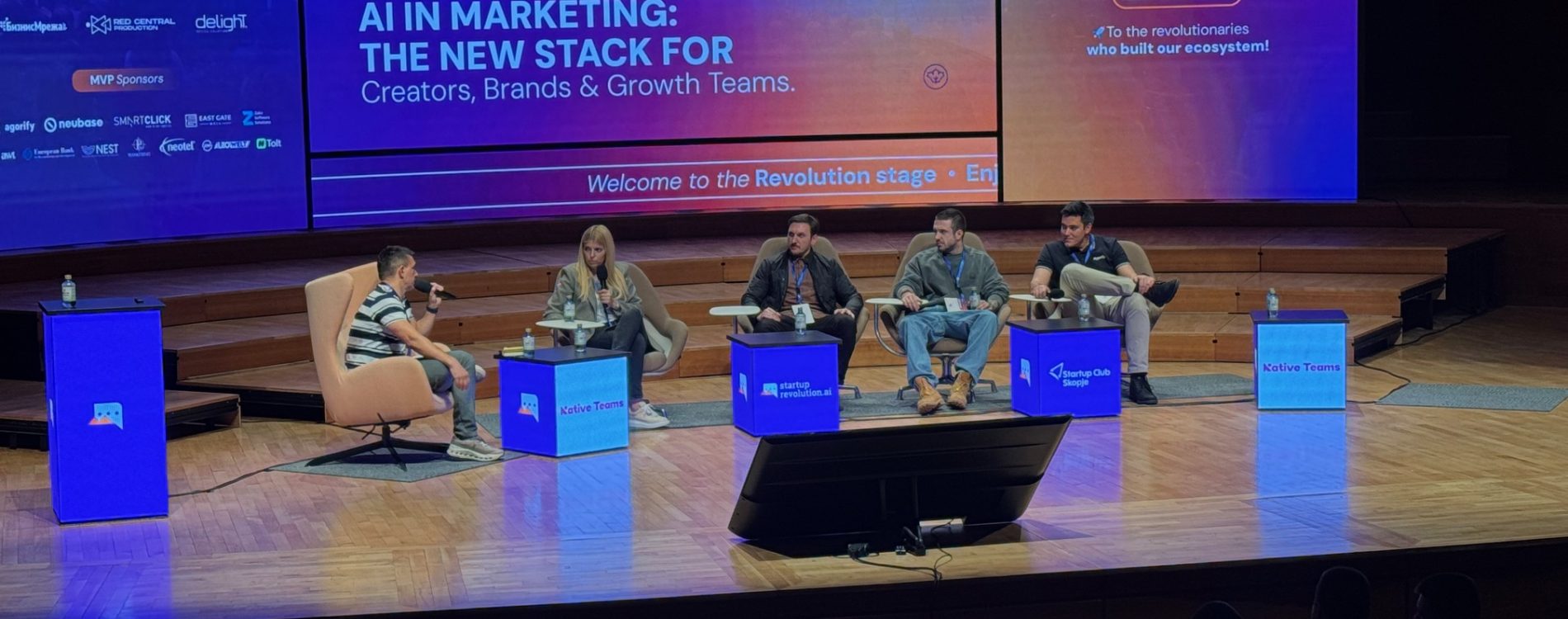

One of the most engaging sessions during Startup Revolution Summit in Skopje, Macedonia last week turned out to be a discussion about how AI is influencing the world of marketing and the creator economy. The panel brought together founders building very different products in the same ecosystem, yet their perspectives converged on a shared idea: AI is becoming most valuable not by replacing creativity, but by taking over the repetitive work that slows teams down.
All four offered an honest and often humorous look into how brands, agencies, and marketing teams are already changing their processes around automation in day-to-day execution.
When 90% of the job isn’t the job
For Stjepan Zelić, founder of Croatia-based AI-powered influencer marketing platform Hypefy, the biggest bottleneck in influencer marketing has never been creativity – it’s everything around it. Research, outreach, pricing, negotiation, reporting. None of it is what marketers dreamed of doing when they imagined “creative work.”
“I think as humans, we like to think we are super smart, right?” he said. “We love feeling good when we solve something that we think, oh, this requires big brains so like, big brain time?”
His point, however, was that most marketing tasks don’t actually fall into that category. “The truth is, with many other industries, 90% of the work that you do is stupid, right? It’s repetitive. It’s nothing that requires big brains.”
He noted that humans tend to choose influencers based on instinct – which looks like expertise but is actually bias. “Two different brand managers will pick two different content creators because of some random, biased feeling that you have,” he said. “But if you think about which audience you’re trying to target, then data comes into play.”
Hypefy’s solution is to remove the instinct-based part entirely. “We tell customers immediately – you don’t get to pick anything. Leave AI to do it, and when AI does it, it works wonderfully.”
Zelić compared the ideal workflow to movie CGI: invisible when done well. “If you don’t notice what’s happening in the background, it just happens, then it’s good.” And while AI handles selection, negotiation, pricing, and organization, he was clear about where humans still matter: “The creative part, we leave that to the humans, because humans are still more powerful.”
Listening to social signals and acting on them quickly
For Clearcue’s founder Ralitsa Ivanova, the transformation of marketing in the last year comes down to scale. Not scale in spend, but in awareness – the level of context teams can gather about customers in real time.
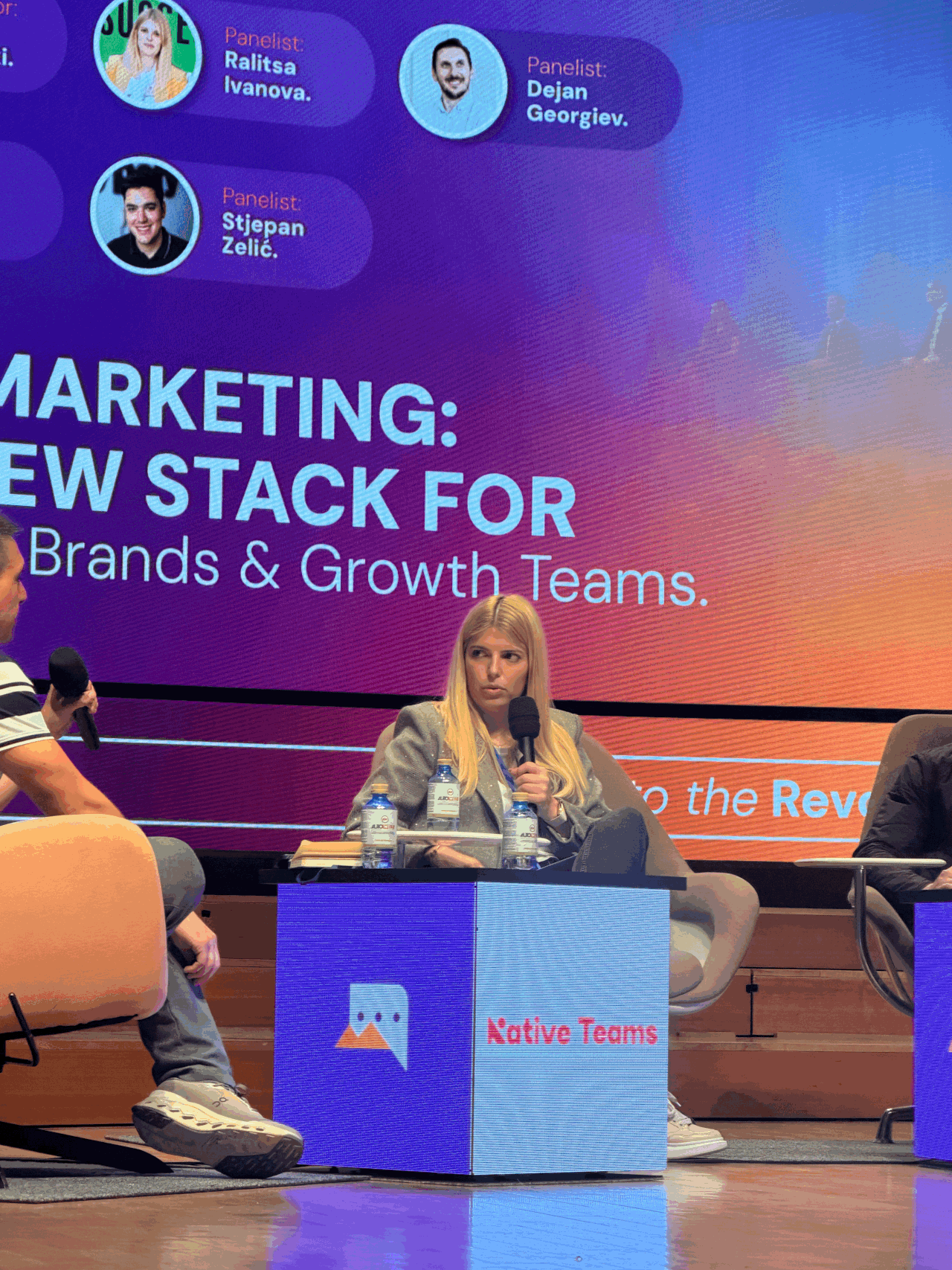
“What has happened in the last year? Everything changed. We can analyze data at scale… and that is the key thing that is making a great campaign, great content, or great sales outreach.” she said.
Clearcue tracks online signals that indicate what potential customers are thinking – keywords they mention, posts they engage with, influencers they follow, events they reference. These pieces of information are small individually, but powerful once stitched together.
“If you’re doing it at scale – analyzing all of those people at scale – and tracking the small logical hacks that prove a person or a company can become your customer, then you can create a whole automated flow where all of your leads are tracked by AI,” she explained.
And the time savings are measurable. “A couple of weeks of one person’s time becomes 10 minutes for 20, 30, 50 content creators – because everything is handled by AI,” Ivanova said. The only part that scales upward for humans is content review: “There’s more content now, so that’s where they have more work – but 90% of the time goes down.”
Superhuman intuition – just scaled
Influencers Club, represented by co-founder Nikola Sokolov, sits further down the stack – their clients are often the companies building influencer platforms and AI discovery tools. For Sokolov, the conversation isn’t about whether AI can replace human intuition. It is about multiplying what already works.
“It’s not about what AI can do that the human cannot. It’s about how do we get this to work at scale.” he said.
With a dataset of hundreds of millions of creators, the company provides the backbone that lets other platforms automate discovery and matching. Yet despite the volumes of data involved, Sokolov sees emotion as something that shouldn’t be engineered out of the industry.
“I just don’t want to make it programmatic. The future of influencer marketing might end up being programmatic, where you launch creative ads the same way you launch Google ads, YouTube ads, or whatever. But it’s still energy. It’s still how do you feel about this person representing your brand.” he said.
He also pointed out something many founders in the region rarely hear: this time, they’re not late to the wave. “Railways were late, planes were late, everything was late. AI is here now. Let’s make the most of it.”
The new AI-powered marketing team
Uliasti founder Dejan Georgiev shifted focus from tools to the future structure of marketing teams themselves. The change, he argued, isn’t just technological, but organizational.
“What humans can do, and what AI can do, is simple to answer. Humans have feelings, have creativity and conscience. In this regard, humans define workflows that can help scale your product or enrich your workflows.” he said.
The next phase, however, won’t simply be layering AI onto the current setup. “We still make mistakes, or we are still learning how we orchestrate these agents,” he explained. “We think that old processes can be orchestrated – put an AI on it – and we expect magic to happen. It’s not going to work that way.”
His prediction is clear: marketing teams will shrink, not because they become less valuable, but because their work becomes more strategic. “I will see marketing teams going from 10 people to two people, orchestrating agents to do the repetitive work. That’s going to happen probably in the next two to three years.” Georgiev added.
The outcome, if done right, is not a loss of human value, but the opposite. “The customer will be more satisfied, but with less human involvement in the analysis or document scanning or any repetitive task.” he concluded.