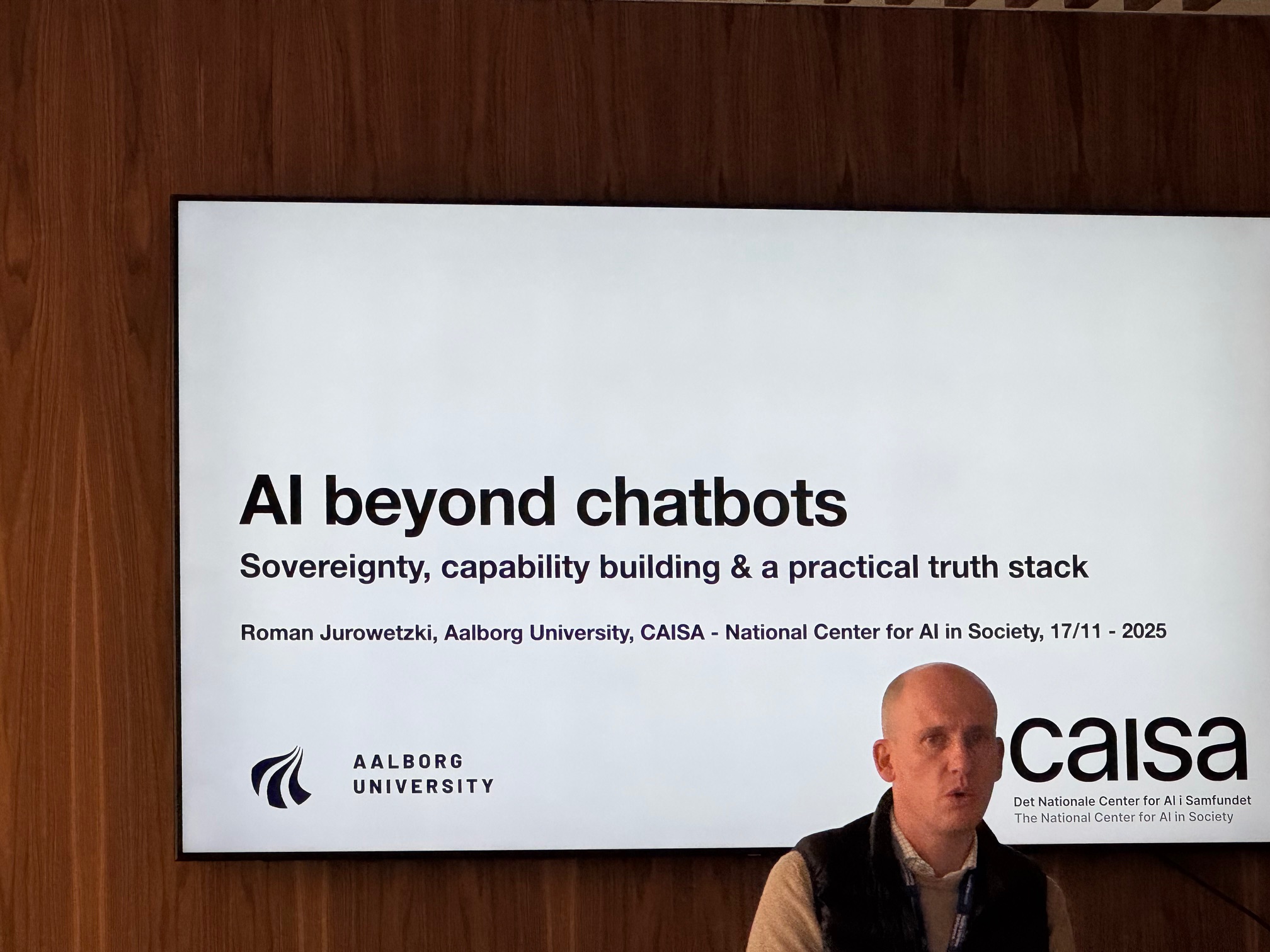
During the EU–Western Balkans Media Literacy Conference 2025 in Skopje, Macedonia, Professor Roman Jurowetzki of Aalborg University sent a clear message: If offense uses AI, defense must too – but not as a single oracle that knows everything, rather as a coordinated system.
In his view, treating AI as magic is dangerous. When the offensive side scales faster than the defensive side, information environments become ungovernable. But when AI-enabled defense is paired with content provenance, strong newsroom processes, and a polycentric “truth stack,” societies can stay resilient – even in a world of synthetic media, rapid disinformation, and geopolitical competition.
In an interview with IT Logs, Jurowetzki argues that the risks are not only technical, but institutional: AI models are advancing rapidly, yet organizations struggle to deploy them reliably. Closing this capability–reliability gap will define the next phase of media resilience, especially for small countries that cannot build their own foundation models but can still build strong, tailored AI solutions.
IT Logs: Could you tell us a bit about your background and your involvement in the AI sector?
Roman Jurowetzki: I am an Associate Professor at Aalborg University Business School, and an economist by training. My work focuses on innovation economics – essentially understanding how technology creates value in companies and across countries. Over the past 12–13 years, I’ve been developing AI tools to support this kind of analysis, so I’ve worked extensively with different types of AI models. It’s been fascinating to finally see these technologies reach a level of maturity that makes them widely useful.
I consider myself both technical and non-technical: grounded in economics but very hands-on with AI systems. Currently, I also serve as the Chief Scientist at the newly established National Center for AI and Society, launched in 2025 in Denmark under the Ministry of Digitalization.
You’ve stressed that we should view AI as a normal technology rather than something magical, which is how many people see it today. Why?
RJ: It’s important because this is almost a philosophical – even religious – choice we make. If you believe AI is something beyond technology, something like Artificial General Intelligence or a kind of higher entity, then a lot of what’s happening in the U.S. becomes easy to explain: of course you would invest enormous amounts of money and push the field as hard as possible. And if you truly believe a god-like AI is coming, then many of the debates we’re having right now become pointless. If such an AI arrives, that’s it – either everything becomes a paradise, or we end up in a very different, much darker scenario. There are nuances, of course, but that’s the logic.
On the other hand, if we treat AI as a “normal” technology – albeit a general-purpose one like electricity or the internet – then we can control it. We can start asking specific questions and think realistically about how we adapt society to work with it. That framing gives us more room for action. To me, it’s more reasonable than simply building gigantic cathedrals of GPUs and waiting for the “AI god” to appear and resolve everything. It’s obviously not that simple, but that’s the philosophical fork in the road.
In terms of regulation, what’s the better path for building these kinds of defenses?
RJ: Most of the regulation we have today is based on protecting personal data, protecting society as it is, privacy concerns, and similar issues – and that’s very important. We should absolutely have a strong baseline, and it’s good that the European Union is proactive on this.
But there’s another side to it, and we need to find a good trade-off. Some of the regulation we have now is already creating obstacles for small and medium-sized companies, researchers, and startups. They have a very hard time growing. Even if they receive funding, it’s still difficult – yes, there are sandboxes and support frameworks, but we have to be careful. Big tech companies have the money, the lawyers, and the deep pockets to handle compliance. Smaller European startups don’t. And if they can’t manage compliance, they can’t sell their product. We’re already seeing this: European companies are struggling to sell to European customers.
So if the end result of regulation is that we regulate strictly, but everyone ends up becoming a customer of big tech anyway, I’m not sure that’s progress – we lose the chance to develop our own capabilities. It’s like only ordering burgers because you’re afraid of using a knife or the stove. You protect yourself from cuts and fire, yes, but you never learn how to cook or how to eat healthy. You just keep ordering takeout.
That’s the danger. We need balance. We can’t go to the extreme of “anything is allowed,” but over-regulation also carries risks. It’s difficult. There are many trade-offs, and I know policymakers are trying their best, but it’s a hard problem.
When we talk about this region – small countries that can’t really build their own models or cloud infrastructure – what is the solution? How can we adapt?
RJ: Once you start breaking down what’s actually needed, you quickly realize something important. Take the example of a car: you don’t have to build the engine from scratch, and maybe you shouldn’t. But you should still know how to change the oil or how to jump-start it when the battery is dead. That’s the level of understanding that’s often missing.
As long as we treat AI as this mystical, abstract thing, we never figure out what we “can” do and what we “cannot” do. It becomes speculative. But once you start building tooling and experimenting with concrete projects and real problems, you quickly discover: actually, we can do a lot. A lot of it is simply software development. And I know that N. Macedonia has coders and people who already export that expertise to other countries – so the capability is here.
It’s not really about having 500,000 GPUs. It’s much more about bringing the right people together and asking the right questions: What do we want from AI? Do we want to save time on pointless administrative tasks? If so, when does the system make mistakes? What quality level do we expect? Once you dive into those details, you realize there are so many important questions that have nothing to do with training a large language model.
The truth is, most of the real work is much more boring than the hype suggests. And yes – the boring things need to be done first. No one gets excited about that, but unfortunately, that’s what’s required.
How will we see this progress? Will there be fewer attacks, faster recovery, or citizens who are harder to deceive?
RJ: This is speculation, of course – you’re asking about the future, and I don’t know what the future will be. Maybe the Americans are right and an “AI god” will emerge, and everything we’re talking about now won’t matter. But if that’s not the case, and we do develop these capabilities, then yes, I think we’ll see progress.
For example, spotting disinformation could become much faster. We can use AI to scale up the speed of recognition and flagging, and to build systems that surface potential problems quickly. There was a very interesting study that came out in Germany: participants were shown images labeled as real or fake on the front page of a traditional newspaper. The people who were exposed to this, and who knew they were part of an experiment, later showed a higher tendency to seek out trusted media sources.
So exposing people to these kinds of experiments, almost gamifying awareness, seems to change their mindset. They become more critical and more conscious about where they get information from. I think that kind of behavioral shift is possible.
And finally, I believe we need more technical expertise in policymaking and in the public sector. If we achieve that, I think we’ll start seeing smarter policies in this area.
But again, everything is hypothetical. If things go wrong, the opposite could happen: over-regulation, everyone doing whatever they want, and big tech winning by default. And now we even see China trying to take a very interesting position on this – possibly something that could be argued as better than the American approach. So, the competition and experimentation are clearly already happening.