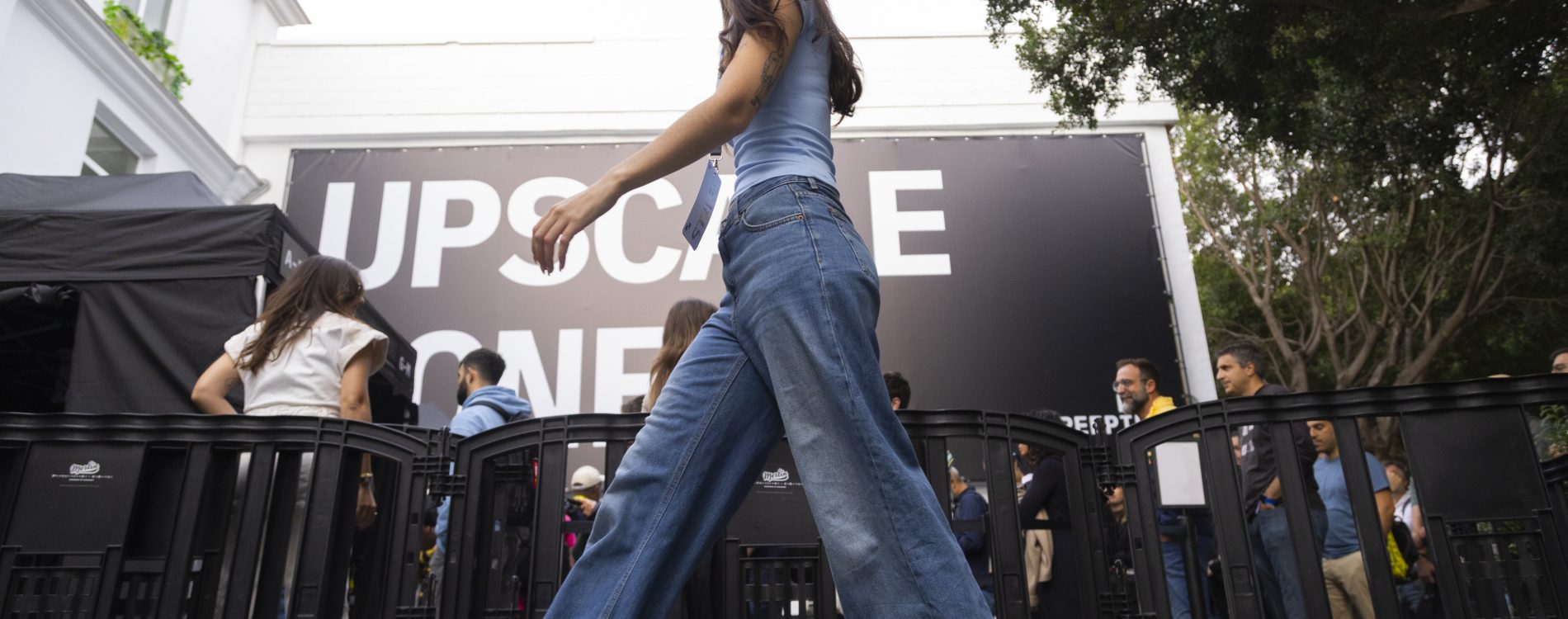
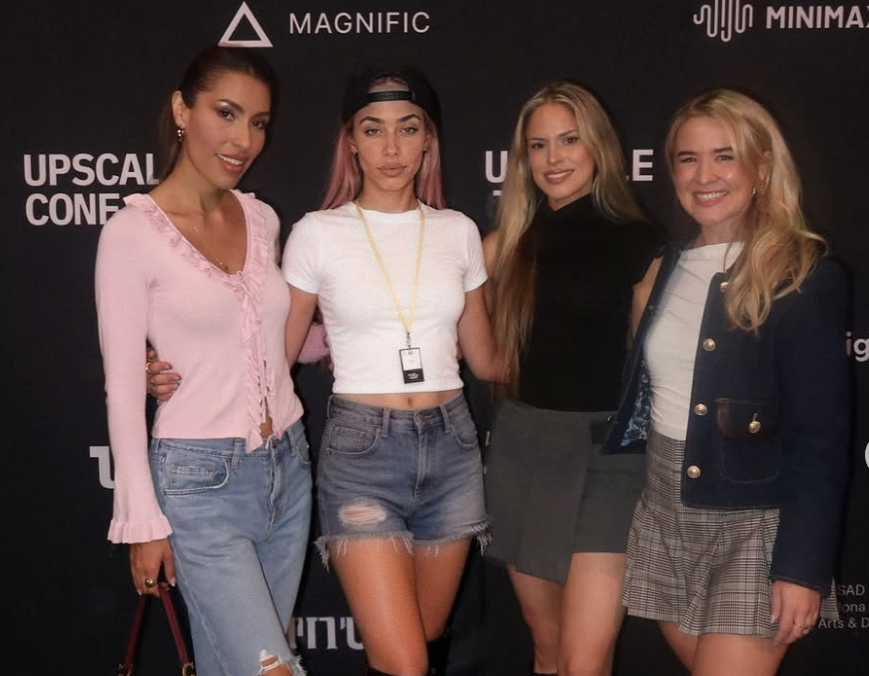
At the Upscale Conf in Málaga, visual and graphic artists were everywhere – hunched over laptops, sketching on tablets, testing AI-generated effects, and experimenting with augmented reality filters. It was the perfect environment to meet two of the most innovative voices in this space: Maria Pratt and Paige Piskin, both of whom have turned AI into a tool for storytelling, experimentation, and connection with massive online audiences.
Sitting down and discussing these topics with them, it quickly became clear how AI is reshaping not only the way content is made, but also how it’s perceived. Maria, whose cinematic AI videos on Instagram have racked up millions of views, spoke about her journey from a traditional career in finance to pioneering AI storytelling. Paige, a digital media veteran and early AR creator, shared how integrating AI into her workflow accelerated her creativity and allowed her to experiment in ways that were previously impossible.
What began with their personal backgrounds evolved into a deep dive into their lives as AI creators and influencers, boasting over a million followers on Instagram and countless more across all their platforms.
IT Logs: Tell us a bit about your background – how did you end up living this life as an AI content creator and influencer?
Maria Pratt: I’m a content creator, mainly on Instagram, where I make cinematic videos that merge real-life scenes with AI. My background was actually in financial analysis – I worked for a bank, a financial institution. Something totally different, and honestly, very boring! But I always had this creative urge. On the side, I was active on Instagram, posting travel and fashion content.
When AI started gaining traction, I became one of the first creators to make a video using it. At the time, I couldn’t travel for about a month but still wanted to post something cool, so I thought, why not try AI and show people how I did it? That was in 2023, during the early days of the AI boom. The video went viral – it hit 55 million views – and my life changed completely. I decided to focus fully on AI, using it as a creative tool to make beautiful videos. Since then, I’ve had amazing opportunities working with companies like Adobe and Freepik. It’s been an incredible ride.
Paige Piskin: I’ve been working in digital media since 2010. I actually started out as a MySpace content creator – that was my first experience with social media and seeing its potential. From there, I kept going, learning how to monetize and work across different platforms. I moved into management, helping influencers and creating marketing campaigns, and eventually transitioned into XR, which was my first real step as a digital artist exploring emerging tech.
I started creating AR filters for my social accounts and for brands, which led to huge opportunities. My audience grew by around two million followers, and I got to work with incredible brands like Netflix and Bratz. My filters ended up getting about 300 billion impressions.
While making AR effects, I began integrating AI tools into my workflow – I was an early beta tester for DALL·E – and that allowed me to create much faster by generating textures, 3D models, and animations instead of building everything manually. That’s when I realized AI was the future of digital creation. I was about to start learning traditional VFX to make fake out-of-home videos for brands when I thought that maybe I should just learn AI instead. So I pivoted fully into AI, and it’s been an amazing adventure learning these tools and finding new ways to express myself.
What kind of feedback have you been getting from your followers?
Maria Pratt: Well, initially, this was back in 2023, people were freaking out. They were skeptical and even scared. Many thought, “what’s going to happen now?” Social media already felt fake, and they worried AI would make it worse. One woman even commented, “Jesus, take me anytime now.” It was wild.
At first, the backlash was more about AI in general, but later it became personal. Some people didn’t like that I was using AI at all. They said I was promoting fakeness or “teaching people to be fake.” Then came the environmental angle – a lot of viral videos were circulating about how data centers and GPUs were damaging the planet, and people would send them to me, saying things like, “You’re killing the environment one prompt at a time.”
So yeah, there was a lot of pushback at the beginning. But now it’s toned down quite a bit. People are more curious, they ask how I do things instead of reacting with fear. I wouldn’t say everyone has embraced AI yet, but the conversation is shifting. There’s less hate, which is great – though ironically, that also means fewer viral moments. It’s a bit of a double-edged sword.
Paige Piskin: I’ve had a similar experience. Most of the things I’ve created have always had a slightly controversial edge. When I worked in AR, I made character transformations and beauty filters – which were very polarizing. Some people felt they promoted unrealistic standards, while others saw them as creative and fun ways to express themselves, like turning into a Hulk or an avatar.
It’s the same with AI – some followers raise concerns about the environment, creativity, or job loss. But lately, I’ve noticed people are becoming more understanding as they see the process behind what we do. They realize that I train my own models and use my own content – just like Maria uses her own photos and videos. They can tell now that it’s not just “one prompt and done.” It takes many steps, a lot of manual editing, and real creative effort.
Maria Pratt: In the beginning, a lot of people were also worried about their jobs. Many photographers commented things like, “I’m done as a photographer, my career is over.” But now, you can see that some of them have either moved on or started embracing AI as a tool. They’ve realized it’s not replacing them – it’s something they can use to enhance their work. So, in that sense, things have definitely changed since my very first post.
Paige Piskin: I just want to add to that. My background before all of this was in photo manipulation and digital compositing. What generative fill does automatically now, I used to do by hand back around 2010 – using brushes, stock images, layering, painting, erasing – it took forever to make an image into something new. When generative fill came out, I thought it was incredible. I wasn’t scared of it at all. It was doing what I already did, just faster, and still following my creative vision — only with more efficient tools. So I think it’s all about perspective. You’re right, more photographers are starting to see it that way too – as something that helps them achieve their results faster.
In that sense, what do you see as the future of content creation? Do you think it will become some kind of fusion between AI and human creativity, like what you’re both doing now?
Maria Pratt: I think so, that’s definitely where content creation is heading. I believe we’ll see even more creators emerging because AI is lowering the barriers to entry. It has democratized tools that used to take months or years to learn. Even 3D design, for example, is now much more accessible. So yes, more people will be able to create, which means more competition too. But I think the future will continue to blend real-life elements with AI. That’s what I focus on and plan to keep doing. I don’t think I’ll ever go fully AI – at least not for now – but who knows? Either way, I think that human-AI fusion is the future.
Paige Piskin: I feel the same. The future is really about that human connection with AI – using it as a tool, but also as something deeply personal. I think AI models will keep becoming more personalized, and the intelligence we interact with – language models, creative tools, all of it – will become tailored to each individual. In the future, you won’t just see one recognizable “AI style” like we do now with certain platforms. Everyone will have their own unique style reflected in what they create. It’ll feel less artificial and more like an extension of ourselves. And when that happens, AI won’t seem so intimidating anymore – it’ll just be the norm.
What’s your message for content creators who want to start working with AI?
Maria Pratt: I’d say just go for it. AI gives everyone the opportunity to express their creativity and share it with the world. With platforms like Instagram and X, and with AI making the process so much easier, there’s no better time to start. Use AI as a tool to create whatever you love.
Paige Piskin: I completely agree. If you’ve ever had an idea, whether it’s an app, a movie, or any creative project, now is the time to make it happen. The barriers to entry are lower than ever, and there are fewer limits to what you can create. It’s an incredible moment to take advantage of that. Don’t be afraid or feel like you’re too late, because it’s still very early. New tools come out every week, and we’re all learning together. So it’s never too late to jump in.